The Meter Is Running
Back in early June, Anthropic announced Fable 5 as a model with capabilities "exceeding those of any model ever made generally available." Its performance in all knowledge work, from software engineering to scientific research, was so "exceptional" that three days after the launch, the US government ordered Anthropic to suspend all access. Access was restored a few days later with "improved safeguards" and a hard deadline: subscribers could use it for one week before the model would move to usage credits only. The deadline got pushed three separate times before it finally stuck.
The way Anthropic rugpulled Fable 5 from subscribers' plans reminded me of 'the first taste tactic'. Like an ice cream shop handing out tiny plastic spoons to let everyone have a taste of their newest flavor, Anthropic knows that just a taste will become a whole cone plus toppings plus a return visit. All they have to do is activate your taste buds. Their gift of a one-time $100 credit, allowing subscribers to continue using Fable 5 for two million output tokens (which in practice amounts to roughly one deep agentic coding session), resembles these types of drug dealer antics even more.
While this change in how AI is being sold is happening, AI policies should focus on more than just security, privacy and acceptable use. Companies need to think about metering, work habits, cognitive load and the skills their employees may be outsourcing to machines.
the metered model
Back in March, OpenAI's Sam Altman announced that intelligence will eventually be sold as a basic utility, like electricity or water, that's metered by usage. Despite some backlash over concentration of power and control of knowledge, this shift in unit economics looks like the way forward for AI labs. Economically, this makes sense, given how AI is yet to become even remotely profitable. The companies behind our beloved frontier models are burning billions at an unprecedented rate, and the subscriptions that we've all gotten used to (about $20 per month) turn out to be heavily subsidized. The recurring revenue may look attractive, but it is nowhere near enough to cover the cost of serving that usage, let alone turn a profit. The bill has to land somewhere, and the industry is slowly deciding that it should land closer to the user.
Interestingly, this isn't the only thing Altman recently reversed. After calling ads in AI "uniquely disturbing" and a "last resort" back in 2024, OpenAI did end up rolling out ads earlier this year after hiring the head of Facebook's ad machine. We're starting to see a recurring pattern: AI companies adamantly state their principles, which later give way under structural pressure.
The initial problem with AI spitting out hundreds of lines of text onto your project was maintainability, but token economics is now a growing concern. AI moving toward a metered model means its users now suddenly have to be mindful of their token usage. Most agentic tools, especially the ones where you can spin up tens of sub-agents for a task, are the opposite of mindful; they are extremely token-hungry instead. While rewriting Check's AI policy, we realized that a values-only approach would be incomplete. If intelligence is becoming a metered utility, usage itself belongs in the policy.
usage limits are steering behavior
Every AI subscription relies on the same finite resource: compute. The question is whether the cost of the computations is disclosed or disguised. Fable 5's move to usage credits is what I'll call hard metering: pay-per-token, visible, a number going up in real time. What users on a subsidized plan have been using is soft metering: a flat monthly fee that feels unlimited, until you hit a time-boxed window and get cut off. The subsidies behind soft-metered plans are cracking, and so the disguises are becoming thinner.
Anthropic's cheapest plan comes with rolling 5-hour usage sessions. After burning through an unknown amount of tokens (all you see is arbitrary percentage values), you lose access to all models on the platform. Users have to wait until this 5-hour window passes so that the limit resets and they can prompt again. Anthropic's highest pricing tier comes with "20 times as much usage as Pro", but it's unclear what 20x of something really is. And with models and harnesses getting hungrier, it takes less actual work to reach those limits with every new frontier model's release. The limits come in different shapes: a 5-hour window, a daily or weekly ceiling, or a mysterious percentage bar that refuses to explain itself. But the behavioral effect is the same: users start planning their work around the meter.
Software engineers have found creative ways to optimize their output while staying within the limits of their soft-metered plans. Timing the 5-hour windows around coffee and lunch breaks is an obvious one, but I've seen more creative tactics just to make sure the usage window resets as often as possible during a single working day. These tactics include sending an automated prompt early in the morning before the working day starts, just to trigger a usage window that ends around 11:00. Then making sure a prompt is sent right after that reset, which triggers a new window that finishes late afternoon around 16:00, allowing you to fit in one last agentic session before closing the laptop at the end of the day.
But what happens after the limits are reached? Do engineers resort to writing lines of code by hand, dusting off the skill that the tools were supposed to make optional? Or do they just sit there, waiting for their time-boxed limit to reset? Everyone handles their cooldown period differently based on personal factors like discipline, work ethic and passion. But what's the same for everyone on these soft-metered plans is that the agentic tools are impacting the schedule of when and how they work, instead of them following their own productive rhythms.
Check's new AI policy
Companies in 2026 are having a hard time adapting to the disruptions that AI is bringing. And as a shared mobility operator in the Netherlands with about 50 office workers, Check also needs to find a way to navigate this new reality. On one hand we want to give everyone access to technologies that make people’s jobs easier, optimize workflows, and allow everyone to find creative new ways to improve their work. On the other hand, we also need to make sure the rollout is done well, with not just an eye on security and data privacy, but also the ethical and psychological aspects: how do we make sure nobody feels threatened by the possibility of being replaced, and how to deal with other existential questions that working with this technology might bring? Check isn't unique in facing this. Every company right now is improvising answers to the same problems.
In an earlier version of the policy, we tried self-hosting several open source models on our own Kubernetes cluster, as well as an OpenWebUI frontend so that our colleagues could safely interact with AI without data ever leaving our own environments. But this proved to be the wrong way forward. Even though OpenWebUI is a great harness and used by several big enterprises, its capabilities do not match those of the AI behemoths. Additionally, models in the open source frontier, like Z.ai's GLM-5.2 and Moonshot's Kimi K3, are not cost-effective to self-host as they require clusters packed with expensive GPUs. Meanwhile, the smaller open source models that are easy to self-host are not on par with the intelligence of frontier models. They're great for automating simple workflows, but still far from good enough to bring real value to deep office work.
So what would work? We noticed a split in how colleagues want to use AI, and identified two camps that we've started calling 'light mode' and 'dark mode' users. Engineering and operations teams are enthusiastic about the power that AI brings in coding and automations: dark mode terminal work around direct model access. Other teams like to use it to create marketing visuals, draft business plans, or grammar-check emails: light mode browser work that relies more on the product around the model that's provided.
We've settled on Gemini because Google is, after a slower start, now actively competing with other frontier models like ChatGPT and Claude. The feature set is broad (text, images, videos, automations), the UX is easy, and it integrates seamlessly with everyone's Google work account. This does put our light mode users on a soft-metered plan, in the form of a Workspace seat license, which means that we'll feel it if Google ever starts squeezing that plan. It may look lower-risk than engineering, but office AI is quietly becoming context-hungry too. Every simple request can drag along Gmail, Calendar, Drive, Docs, Meet transcripts and chat history. Those are tokens too. Also, while our dark mode tool went through due diligence around security and privacy, Gemini earned our trust with Google's ever-charming smile. They claim that they take security and privacy "very seriously", which is as reliable as a firm handshake and prolonged eye contact. But, with Check already using Google Workspace since its founding, it was a logical choice.
On the dark mode side, we chose Opper, an AI gateway based in Stockholm. Their API is a drop-in replacement for any of the frontier models' SDKs, so it plugs straight into existing tools and gives instant access to 300+ models, including the frontier ones. This helps to avoid vendor lock-in and stay model-agnostic, as it's easy to switch to another provider or model at any point in time. Opper is also very transparent on the data privacy side of things. You can filter on models that are hosted by providers that are EU-based and promise zero data retention, such as evroc, berget, and tensorx. This puts our engineers on hard metering by default: a transparent pay-per-token model without 5-hour countdowns to game. This is not automatically cheaper, but that is partly the point. Hard metering makes the cost visible early, before people have built workflows that rely on someone else eating the compute bill.
Claude Code is excellent, but increasingly tailored to Anthropic's own models. For a company that wants to stay lean and unlocked, there's a dislike for tools that are showing hints of becoming single-provider. So we've been adopting OpenCode: an agentic harness with well-integrated model agnosticism, which goes well on top of Opper for the actual routing. The harness stays neutral, the gateway stays neutral, and we're not dependent on any vendor's roadmap.
As it stands now, we haven't set a hard cap on usage. With a small enough engineering team, we've leaned on visibility before rules. There's an internal leaderboard tracking token usage, and a running exchange of tips on what actually brings usage down. Our iOS engineer Eus built a menu bar app named BurnBuddy that sits in our MacBook menu bars and tells everyone how many tokens (and how much money) they're personally burning each day, while showing a team leaderboard across different time periods, plus a running total of what the company credit card will be charged for at the end of the month. BurnBuddy sparked discussions around smarter context management, tailoring prompts to improve prompt caching, and avoiding running dozens of sub-agents that multiply token burn. We rely less on policy than on culture, which works well at this team's size and scale, but might be hard to scale to a few hundred engineers. At that point you probably want actual per-user limits, not just a vibe.
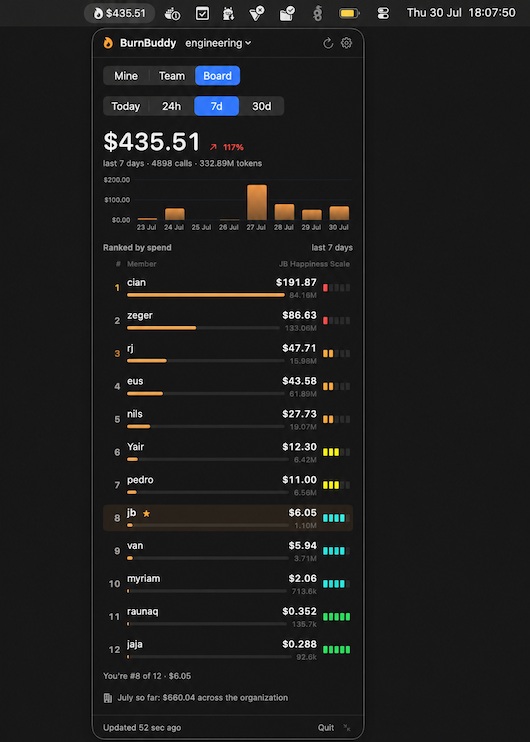 BurnBuddy in action
So this is where we've landed for now, but we realize that any AI policy in 2026 will quickly become outdated, and so will ours. The cards get reshuffled every time a provider changes its pricing, its limits, or the features and restrictions in its toolset. However, instead of waiting for stability that is not coming anytime soon, we're confident in our setup today, while we're equally confident that we'll have to revisit it later.
on becoming editors
Software engineering is becoming more and more editorial work as opposed to actual programming. We're no longer required to manually write lines of code, but can now hand out tasks while overseeing the output as humans in the loop. We're changing our workflows so that all we have to do is accept or reject the lines of code that AI is spitting out, or slightly alter the outputs that were generated. Where just a few years ago engineers would fully grasp the details of their parts of the codebase and confidently release their handwritten changes, we're now handing our bug fixes to agents and trusting the AI-generated tests to be thorough enough before we promote everything to production. Having a tightly sealed layer of monitoring is becoming more important than ever, as error reporting and latency tracking are crucial when dealing with AI-generated services. Anything the human in the loop might've missed must be caught quickly by the platform's observability layer, ideally generating an agentic report for yet another agent to review and act on.
This shift to editing is being sold (and generally felt) as an improvement. We don't have to write every single line ourselves anymore, but can sit back while giving strategic pointers and nudges in the direction we'd like the codebase to go. But research is adding some nuance to the positivity around this: this might be a more taxing form of labor. A recent study on software developers' well-being in the age of GenAI showed that generative AI can "amplify cognitive load, introduce new forms of oversight labor, and escalate expectations around output and pace, contributing to stress, burnout, and diminished work–life balance." AI is filling our plates with work that's about verifying rather than creating, and requires us to bear responsibility for output we didn't write.
Neurologically, studies suggest that people performing the same task with generative AI show less brain activity, less alpha connectivity (creativity), and less theta connectivity (working memory). Using AI in creative processes could gradually reduce the amount of original thinking we do. So as AI is filling up our plates with new kinds of stress, it may also be hollowing out the original thinking that the work once demanded of us, especially when we let it scaffold the task before we have formed our own view.
While the CEOs of the AI labs are claiming that our job will be fully automated by 2027, we have no other option but to participate. Even AI guru and software engineer Andrej Karpathy has described the feeling of being behind. While the profession is being dramatically refactored, he senses that he could be 10x more powerful if he "just uses what has become available over the past year." To avoid that nagging feeling, we're all frantically adopting AI in our workflows, without second-guessing whether certain parts of our workflows should be offloaded at all. And so I've also found myself accepting diffs that I could not clearly explain to a colleague just a few hours later. I reviewed the code and approved it, but somehow my understanding of it was less solid than if I had written it myself.
Another insidious mechanism is that AI oozes confidence without any social cost for being wrong. Unlike confidently wrong humans, AI has no reputation on the line, no history of failure, and its tone comes across as real expertise. When we can no longer distinguish earned authority from a convincing imitation of it, all the effort we put into building credibility ourselves can start to feel pointless. When people lose confidence in their own judgement, they do not necessarily become more analytical. They simplify, defer to the most decisive-sounding source, or disengage entirely.
This is my worry about authors becoming editors in any field of knowledge work, not just software engineering. Good editing requires a confident reader, someone who can tell good judgement from bad and who trusts their own sense of when something is right or wrong. But that's precisely what AI is eroding: first by making our own hard-won expertise feel redundant, and second by making it harder to trust our own read of what's actually true, correct, or working. We're required to sit in the loop and supervise a process, while our capacity for judgement is being hollowed out by the thing we're supposed to be supervising.
the tasks worth keeping
Yuval Noah Harari believes that the rapid changes of this revolution are likely to cause a mental-health crisis as humans struggle to adapt. Living through this "biggest psychological experiment in human history" is interesting, because it is inviting us to think about our work on a philosophical level. What kind of work do I no longer have to do myself? Which aspects of my work do I still find satisfying to do myself? And what happens if humans are no longer strictly needed for knowledge work in general?
I believe companies in 2026 should spark discussions about AI on this deeper level, and not just treat it as another technology to adopt. AI policies should be more than just which tooling is allowed and bullet point lists of do's and don'ts. Companies are tasked with finding the right balance between encouraging people to learn what this new technology can and cannot (yet) help them with, and providing a safe environment to discuss the psychological side as well.
Because what are the cognitive effects of interacting with AI? Are you still able to write code (or an email, or an essay) from a blank page without any AI scaffolding? Are there any other skills that we are atrophying by offloading everything? Is it that bad to let some skills atrophy when another type of intelligence can do the work for us? I don't have clear answers. But since we introduced our new policy, I've noticed an increase in discussions around AI at the office. It's out of the shadows, and we're shaping whatever this thing needs to be together as a team.
I started sharing the token usage leaderboard in an attempt to keep our bill low. But what BurnBuddy actually ended up being was a shared object to argue about. Watching your name move up a leaderboard for token burn turns out to be a strange kind of mirror. It's hard to see your number creep past a colleague's without asking yourself what you actually did with all those tokens, and whether you could have simply done it by hand. Our written policy mostly describes our tooling of choice, while the real policy turned out to be the conversations. The leaderboard not only tracked usage, but gave us a reason to argue about what should be automated, what shouldn't, and why.
For anything you might work on, ask yourself: Is this like a construction site, or like the gym? On a construction site, machines are amazing — you can lift heavier things and build better buildings with an excavator and a crane. But at the gym, the whole point is to increase your own capacity. With AI, the analogy is that we now all need to figure out where AI can help us do bigger, cooler things, like building personalized software, and where we need to build our own cognitive abilities first, like learning to write.
- Helen Toner, AI policy researcher
I'm not yet at the point where I can tell you which of your specific tasks are more like construction sites or gyms. But I believe going to the mental gym is how we'll be able to keep our judgement as editors strong, and the construction site is wherever we can safely hand that judgement off. Personally, I still celebrate hand-crafted, artisanal code out of passion for the craft, and because I believe some code should be written by a human, not just generated by a model. That's a gym task on purpose to keep our mental muscles strong, so our judgement of AI-generated content doesn't go soft. Beyond that, I don't know yet. Ask me again in six months. I hope to have a better answer by then.